Ranked by our pick, then checks passed, then cost. Time and cost count every try; each dot is one check, in the order listed below (filled: passed, half: partly, empty: failed). Click a model for its notes.
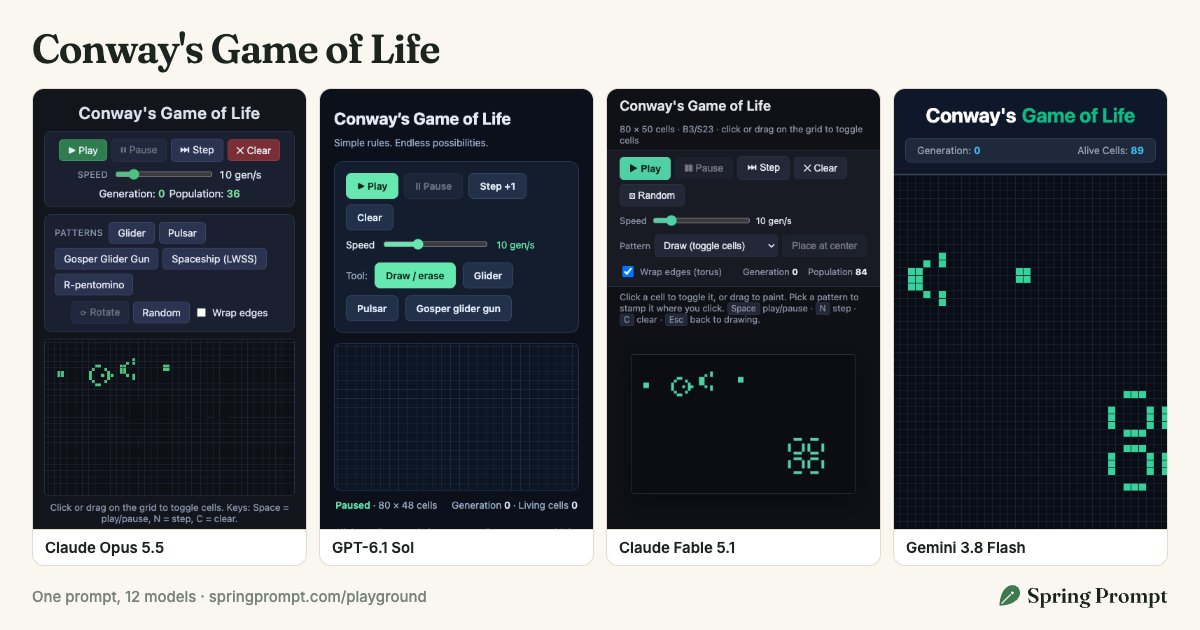
An 80 by 50 board that opens with a gun already running, plus LWSS, R-pentomino, a rotate button and a wrap-edges switch alongside the three asked-for patterns. Every test passed: the blinker flips, the drawn glider keeps its shape and moves one cell diagonally, and the dropped gun fires gliders down and to the right. The most complete of the correct answers, with a pattern that stays armed so you can stamp several in a row.
70 s · 8,631 output tokens (1,577 thinking) · $0.173
A dark 80 by 50 board that opens with a glider, with play, step, clear, a speed slider in generations per second, live generation and population counts, and buttons for the three asked-for patterns. Every test passed: the blinker flips, the drawn glider moves one cell diagonally in four steps, the pulsar repeats every three, and the gun had fired three gliders after 120 generations. The board does not shrink to fit, so it scrolls in a narrow window. The fastest and cheapest of the first eleven answers, at $0.0045 in 35 seconds.
35 s · 8,979 output tokens (2,542 thinking) · $0.005
Added 8 October 2026.
A monospace 80 by 50 board with a pattern dropdown that also includes LWSS, Pentadecathlon, R-pentomino and Acorn, and edges that wrap. Every test passed and the gun fires gliders. The cheapest fully correct answer of the first ten, at $0.021, though it took nearly three minutes.
2.9 min · 17,442 output tokens (11,284 thinking) · $0.021
A dark 80 by 50 board with play, pause, step, clear, a speed slider from 1 to 30 a second and a menu for the click tool. The rules are exact and the speed runs the right way. Glider and pulsar drop in, and the Gosper gun fires: its 36 cells grew by five every 30 generations, with gliders flying off. The judge said the gun was missing a cell; it is not. It is plainer than our pick, with no rotate or wrap. 48 seconds, $0.021.
48 s · 4,215 output tokens (749 thinking) · $0.021
Added 27 October 2026.
A dark 80 by 50 board that opens paused with a pulsar and a glider, with generation and population counts, play, step, clear, a speed slider in generations per second, and buttons for the three patterns, which show a preview, rotate with R and stay armed. The blinker flips, the drawn glider moves one cell diagonally in four steps, the pulsar repeats every three, and the gun had fired four gliders by generation 120. Edges wrap. 79 seconds, $0.029.
79 s · 23,678 output tokens (18,055 thinking) · $0.028
Added 19 October 2026.
An 80 by 48 board in a framed panel, with the controls underneath and Glider, Pulsar, Gosper Gun and LWSS stamp buttons. All the rules tests passed, and the gun fires gliders that wrap round to the top left of the board. The speed slider is labelled in "fps" rather than generations, a small oddity, and it was the fastest of the first ten answers, at 56 seconds.
56 s · 9,751 output tokens (3,408 thinking) · $0.037
A plain dark-blue board of 80 by 48 that starts empty, with a row of tools (Draw / erase, Glider, Pulsar, Gosper glider gun) and a blue preview before you drop a pattern. The blinker flips, the glider moves one cell diagonally in four steps, and the gun fires a steady stream of gliders. It does everything asked and nothing more.
79 s · 5,088 output tokens (450 thinking) · $0.051
A cream, paper-like page with a serif title and dark cells on an 80 by 50 grid, with pill-shaped buttons and the rules spelled out ("Birth 3 · Survival 2 or 3 · Edges stay dead"). Every test passed and the gun fires gliders cleanly. The only light-themed answer, and it took three minutes.
3.0 min · 12,921 output tokens (7,993 thinking) · $0.078
Billed for 1,339 input tokens, about 1,209 more than the other models for the same prompt. We sent no system prompt, and the extra is there on every one of its requests, so it is text the provider adds itself.
A 90 by 60 board, the largest grid here, with the rules printed under a monospace title and a tool row for Draw / Toggle, Glider, Pulsar and Gosper Glider Gun. The blinker, glider, pulsar and gun all behave correctly, and the gun fires a clean stream of gliders. Patterns are centred on the click and clipped at the edge, so dropping the gun near a corner cuts part of it off.
66 s · 10,968 output tokens (5,882 thinking) · $0.143
An 80 by 50 canvas grid with clear cyan and teal cells. A clicked-in blinker flipped and returned after two steps; a glider moved one cell diagonally after four, and the pulsar returned after three. The Gosper gun produced an escaping glider after 30 steps. Play, pause, step, clear, random and the speed slider worked. 1 try, 4.9 min, $0.2486.
4.9 min · 24,832 output tokens (16,054 thinking) · $0.249
Added 11 November 2026.
An 80 by 50 board with a pattern library with previews, rotate, keyboard shortcuts and a speed slider from 1 to 60 a second that runs the right way. The rules are exact, and glider, pulsar and gun all behave: the gun grew by five cells every 30 generations. It will not place a pattern too close to the edge, and says so. The judge saw part of the code and failed the controls and patterns; they work. 12 minutes, $0.26.
12 min · 25,813 output tokens (15,238 thinking) · $0.258
Added 27 October 2026.
A compact 80 by 50 board with a pattern dropdown, a "Place at center" button, a wrap toggle (on by default) and keyboard shortcuts listed under the toolbar. The blinker, glider, pulsar and gun all behave correctly, and the gun had fired two gliders after 85 generations. As correct as Opus, but at $0.51 it is the most expensive of the first eighteen answers on the page.
104 s · 10,127 output tokens (2,368 thinking) · $0.508
An 80 by 50 view onto an unbounded plane, so a glider that leaves the edge keeps going out of sight. It opens paused with a Gosper gun loaded, and has play, pause, step, clear, a speed slider from 1 to 60 generations a second, and four patterns (it adds a spaceship) that you pick and then click to place. Every test passed: the blinker flips, the glider keeps its shape and moves one cell diagonally in four steps, the pulsar repeats every three steps, and the gun fires a glider every 30 generations. The slider ran at the speeds it showed. No rotate or wrap switch, which Opus 5.5 has. 3.5 minutes and $0.89, the dearest of the first nineteen answers on this page.
3.5 min · 22,297 output tokens (14,123 thinking) · $0.893
Added 10 November 2026.
A dark 80 by 50 board that starts empty, with Play (which turns into Pause), Step, Clear, a speed slider, generation and population counts, and Glider, Pulsar and Gosper Gun buttons that drop the pattern where you next click. The rules are exact: the dropped glider glides, the pulsar repeats every three generations and the gun fires a stream of gliders. Edges are dead, so a glider that reaches one turns into a block. The "Speed" slider is really the delay between generations: dragging it right slows the board from ten generations a second to one every two seconds. 9 seconds, $0.0019.
- ◐ Play, pause, step, clear and speed work (partly)
9 s · 5,451 output tokens (2,786 thinking) · $0.002
Added 19 October 2026.
A dark 80 by 50 board that starts empty, with play, pause, step, clear, a speed slider in generations per second, generation and population counts, and buttons for the three asked-for patterns that drop each one centred on your click. The rules are exact: the blinker flips, the drawn glider moves one cell diagonally in four steps and the pulsar repeats every three. But the Gosper gun is drawn wrongly (several cells in its left half are in the wrong place), so it churns into spreading debris instead of firing gliders. The cheapest of the first twelve answers, at $0.0035.
- ◐ Glider, pulsar and Gosper glider gun drop in and behave correctly (partly)
53 s · 6,942 output tokens (2,749 thinking) · $0.003
Added 8 October 2026.
A dark 80 by 50 board with generation and live-cell counts, play, pause, step, clear, a speed slider from 1 to 30 generations a second, keyboard shortcuts and pattern buttons with previews. The rules are exact: the blinker flips, the dropped glider moves one cell diagonally in four steps and the pulsar repeats every three. But its Gosper gun is drawn wrong (the right-hand half is garbled and a block is missing), so instead of firing a stream of gliders it breaks up into blocks and a few stray gliders. Cells past the edge count as dead. One try, 5.8 minutes on OpenRouter's free route, so the time is not representative; $0.030 at list prices.
- ◐ Glider, pulsar and Gosper glider gun drop in and behave correctly (partly)
5.8 min · 49,311 output tokens (39,934 thinking) · $0.030
Added 19 October 2026.
A tidy board of exactly 60 by 40 with cyan cells, a dead border and buttons that drop each pattern in the centre. The rules are right (the blinker flips, the glider glides, the pulsar repeats every three steps), but the Gosper gun is drawn wrongly: its left half is a ring, not the real pattern, and after 90 generations it has churned into debris without firing a single glider.
- ◐ Glider, pulsar and Gosper glider gun drop in and behave correctly (partly)
99 s · 8,210 output tokens (3,220 thinking) · $0.035
The most styled answer: a 90 by 56 "cellular automaton" console with counters, undo, a torus or dead-border switch and pattern cards with small previews. The rules are right and the glider and pulsar work, but the Gosper gun has a 2 by 3 block where the 2 by 2 block should be (38 cells instead of 36), so it explodes into chaos instead of firing gliders. It also took over 14 minutes.
- ◐ Glider, pulsar and Gosper glider gun drop in and behave correctly (partly)
14 min · 34,953 output tokens (22,687 thinking) · $0.210
The first two tries ran out of tokens while still thinking; the third, with reasoning turned off, gave an 80 by 50 board with red cells and a dropdown of twelve patterns. The rules are right (the blinker flips and the glider glides), but the pulsar comes out as nine 3 by 3 blocks (84 cells, not 48) and never repeats, and the gun is missing its right-hand block, so it falls apart without firing gliders. A chosen pattern also stays selected, so later clicks keep stamping it instead of toggling cells.
- ✗ Glider, pulsar and Gosper glider gun drop in and behave correctly
112 s · 5,971 output tokens · $0.013 for this answer; 54 min and $0.414 over 3 tries
Took 3 tries: ran out of room at 64,000 tokens; ran out of room at 128,000 tokens; finished at 128,000 tokens, thinking off.
26 s · 15,395 output tokens (11,793 thinking) · $0.008
Added 9 November 2026.
28 s · 4,991 output tokens · $0.050
Added 13 October 2026.
One answer per model, at each model's default settings unless the card says otherwise, through OpenRouter. If an answer ran out of room or stopped short, we asked again with more room, then with thinking off, and say so. This is a quick look, not a benchmark: run it again and every answer will differ. For measured results, see our benchmarks.
What we checked, by trying each answer ourselves: Follows the rules exactly (blinker flips, glider glides); Play, pause, step, clear and speed work; Glider, pulsar and Gosper glider gun drop in and behave correctly; Grid at least 60 by 40. A partial pass counts as half.
Every model got the rules exactly right: in every answer, the blinker flipped and the drawn glider moved one cell diagonally in four steps, and play, pause, step and clear all worked. The difference is the patterns. Claude Opus 5.5 is our pick: everything is correct, and it adds rotate, extra patterns and a wrap switch, in 70 seconds for $0.17. Claude Fable 5.1, GPT-6.1 Sol, Gemini 3.8 Flash, Grok 4.7, Kimi K3 and DeepSeek V4.1 Flash are also fully correct. Gemini 3.8 Flash was the fastest of the first ten answers (56 seconds, $0.037). DeepSeek V4.1 Flash was the cheapest of the first ten answers ($0.021). Claude Fable 5.1 cost $0.51 for much the same result. Claude Haiku 5.5, added on 8 October, is also fully correct, and faster and cheaper than all of them (35 seconds, $0.0045). DeepSeek V4.1 Flash 1017, added on 19 October, is fully correct as well (79 seconds, $0.029).
Of the first ten answers, three got the Gosper gun wrong: Muse Spark's and Qwen's guns turn into debris instead of firing, and Mistral's pulsar and gun are both malformed. Qwen built the most elaborate interface but took over 14 minutes. Mistral needed three tries: the first two ran out of tokens while thinking (64,000 and then 128,000). MiniMax M3.1 Flash, added the same day on OpenRouter's free route, has exact rules and working controls, but its Gosper gun is drawn wrong and breaks up instead of firing. Mercury 3, added on 19 October, has exact rules and a gun that fires, in 9 seconds, but its speed slider runs backwards: dragging it right slows the board down. GPT-6.1 Terra, added on 27 October, is fully correct on a plain board (48 seconds, $0.021). Kimi K3.1 Pro, added the same day, is fully correct as well, with pattern previews, rotate and keyboard shortcuts (12 minutes, $0.26). Claude Fable 5.2, added on 10 November, is fully correct too, on an unbounded plane with a spaceship added to the three patterns, but it took 3.5 minutes and cost $0.89, five times what Opus 5.5's board cost.