Ranked by our pick, then checks passed, then cost. Time and cost count every try; each dot is one check, in the order listed below (filled: passed, half: partly, empty: failed). Click a model for its notes.
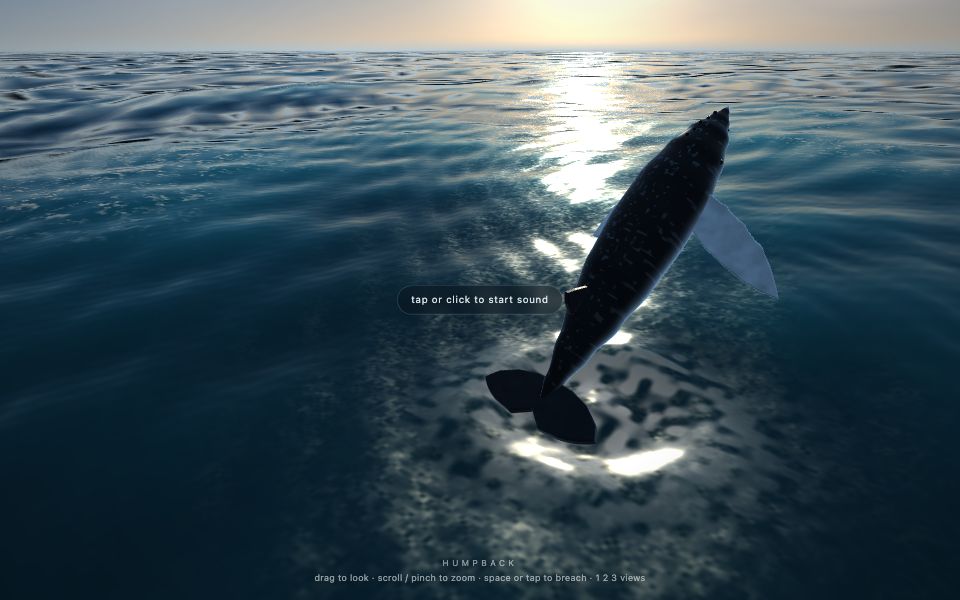
The only working ocean of the first six answers: rolling blue-green water to the horizon, a low sun laying a glittering path across it and a sky that changes with the view. The dark humpback cruises at the surface, then rises almost straight up, shows its pale belly as it twists, and lands in a burst of spray with foam spreading out from the impact. The foam is the weak part: blotchy, camouflage-like patches, and a flat white disc at the centre of the splash. It breaches on its own every 6 to 10 seconds rather than about 12.
- ◐ The landing throws spray, and foam and rings of waves spread out and fade (partly)
13 min · 109,905 output tokens (75,269 thinking) · $0.011
The most convincing sea on the page: deep blue swell out to the horizon under a hazy sun, glitter on the water, whitecaps of foam on the crests, clouds and a few gulls. The humpback has a pleated pale throat, a knobbly dark back, long white pectoral fins and a fluke. On Space or a tap, and on its own about every 12 seconds, it rises almost straight up until most of its body is clear, rolls onto its back as it falls and lands in a burst of spray; a patch of foam spreads and fades and rings of waves run out from it. Keys 1 to 3 give a view from the surface, a wide one and one from above, and dragging and zooming work. The weak part is between breaches: the whale swims under the surface, so from above you see its pale fins and a shadow, and from the waterline almost nothing. From the wide view the whale is small. We could not listen to the sound. Its first try, at its default thinking, used all 128,000 tokens it can write and sent nothing; the second, at low thinking, finished. The two tries took 35 minutes and cost $7.91, the dearest of the first seven answers on this page.
- ◐ Between breaches you can see the whale swimming along the surface (partly)
12 min · 69,522 output tokens (48,248 thinking) · $2.785 for this answer; 35 min and $7.909 over 2 tries
Took 2 tries: ran out of room at 128,000 tokens; finished at 128,000 tokens, low thinking.Added 10 November 2026.
"Pelagic", the best whale of the first four answers: a grey-blue humpback with a white belly, knobbly head, long pale pectoral fins and a notched fluke, which leaps clear, rolls through the air and comes down on its back, with views called Waterline, Wide and Portrait. But there is no sea. The ocean shader names a variable <code>patch</code>, a word WebGL 2 reserves, so it does not compile and the whale swims and breaches against a grey haze, with only faint rings where it lands.
- ✗ An ocean surface with moving waves out to the horizon, light that changes with angle, and foam
- ◐ Between breaches you can see the whale swimming along the surface (partly)
- ◐ The landing throws spray, and foam and rings of waves spread out and fade (partly)
5.4 min · 16,526 output tokens (3,624 thinking) · $0.166
"Humpback: Pelagic Study", a well-shaped whale with long pale fins, a grooved belly and a fluke, which swims, rises nearly straight up, turns in the air and lands on its side in a burst of spray, with a status line, a countdown to the next breach, buttons for three views and a sound switch. But there is no sea: like GPT-6.1 Sol's and MiniMax M3.1 Flash's, its ocean shader names a variable <code>patch</code>, a word WebGL 2 reserves, so it does not compile and the water is a flat black plane under a pale sky. Space, a tap, keys 1 to 3, dragging and zooming all work, and it breaches on its own. 23 minutes, $0.48.
- ✗ An ocean surface with moving waves out to the horizon, light that changes with angle, and foam
- ◐ Between breaches you can see the whale swimming along the surface (partly)
- ◐ The landing throws spray, and foam and rings of waves spread out and fade (partly)
23 min · 47,837 output tokens (32,143 thinking) · $0.479
Added 27 October 2026.
"Humpback Breach: Open Ocean Study", with a status line ("Breaching · airborne", "Impact · foam and pressure rings") and a countdown to the next breach. The whale is a small dark silhouette with long fins that rises straight up, and the landing throws up a column of spray balls with cloud-like foam. Like GPT-6.1 Sol's, its ocean shader uses the reserved word <code>patch</code> and fails to compile, so the sea is a flat teal plane with no waves.
Missed or only partly met 5 of the 6 checks.
7.2 min · 55,065 output tokens (35,834 thinking) · $0.033
2.0 min · 65,642 output tokens (51,113 thinking) · $0.033
Added 9 November 2026.
A blank page: a flat pale blue with the title "Breaching" and its control hints, and nothing else. The code loads three.js and OrbitControls straight from the CDN, but OrbitControls imports "three" by name and the page has no import map to say where that is, so the browser stops before any of the script runs. Space, taps and keys do nothing. The ocean, whale and sound it wrote never appear. 113 seconds, $0.051.
Failed every check.
113 s · 10,109 output tokens (1,770 thinking) · $0.051
Added 27 October 2026.
Nothing to see: the page stays black behind its control hints. While building the whale it merges about a dozen pieces into one mesh, but the bumps for the tubercles and eyes carry texture coordinates and the body does not, so three.js refuses to merge them and the script stops before the first frame. At its default thinking it used all 128,000 tokens it can write without finishing; this is the second try, at low thinking.
Failed every check.
11 min · 69,341 output tokens (42,838 thinking) · $1.389 for this answer; 32 min and $3.951 over 2 tries
Took 2 tries: ran out of room at 128,000 tokens; finished at 128,000 tokens, low thinking.
One answer per model, at each model's default settings unless the card says otherwise, through OpenRouter. If an answer ran out of room or stopped short, we asked again with more room, then with thinking off, and say so. This is a quick look, not a benchmark: run it again and every answer will differ. For measured results, see our benchmarks.
What we checked, by trying each answer ourselves: An ocean surface with moving waves out to the horizon, light that changes with angle, and foam; The whale reads as a humpback, with long pectoral fins and a fluke; Between breaches you can see the whale swimming along the surface; It rises almost vertically, spins in the air and lands on its side or back; The landing throws spray, and foam and rings of waves spread out and fade; Space or a tap breaches at once, it also breaches on its own, keys 1–3 change the view, and you can drag and zoom. A partial pass counts as half.
DeepSeek V4.1 Flash 1017 was the only one of the first six answers with both a sea and a whale: sun on moving water, a breach with a twist, and spray and foam where it lands, for about a cent. GPT-6.1 Sol built the best whale and the best breach of the first four, but its ocean shader uses a word WebGL 2 reserves (patch) and never compiles, so the whale leaps through grey haze. MiniMax M3.1 Flash made the same mistake with the same word, and so did Kimi K3.1 Pro, added on 27 October: a good whale, a clean breach and a burst of spray over a flat black plane ($0.48, 23 minutes). GPT-6.1 Terra, added the same day, drew nothing: it loads OrbitControls without the import map that file needs, so the script never starts ($0.051, 113 seconds). Claude Opus 5.5 ran out of room at its default thinking, and its second try stops before drawing anything. Three of the first six answers came down to one variable name and a fourth to one missing line, which a coding agent would probably have caught on its first run and a single answer could not.
Claude Fable 5.2, added on 10 November, is the second answer with both, and the better-looking scene: whitecaps and sun glitter out to the horizon, a pleated humpback that leaps clear, rolls and lands on its back, and spray, foam and rings of waves where it lands. Between breaches, though, its whale stays under the surface, where only the pale fins show, while DeepSeek's swims in plain view. The two score the same on our checks, and DeepSeek's cost about a cent, so it stays our pick for now; it is a close call. Claude Fable 5.2 thought through its first try without writing anything, and its two tries took 35 minutes and cost $7.91.